If you spend any time online, you’ve likely seen the claim:
“Pilates isn’t enough. You need to strength train.”
Pilates is often framed as mobility work, a warm-up, or something to add on once you’ve done your “real” workout. Strength training, in contrast, is typically defined as lifting heavy weights in a gym setting.
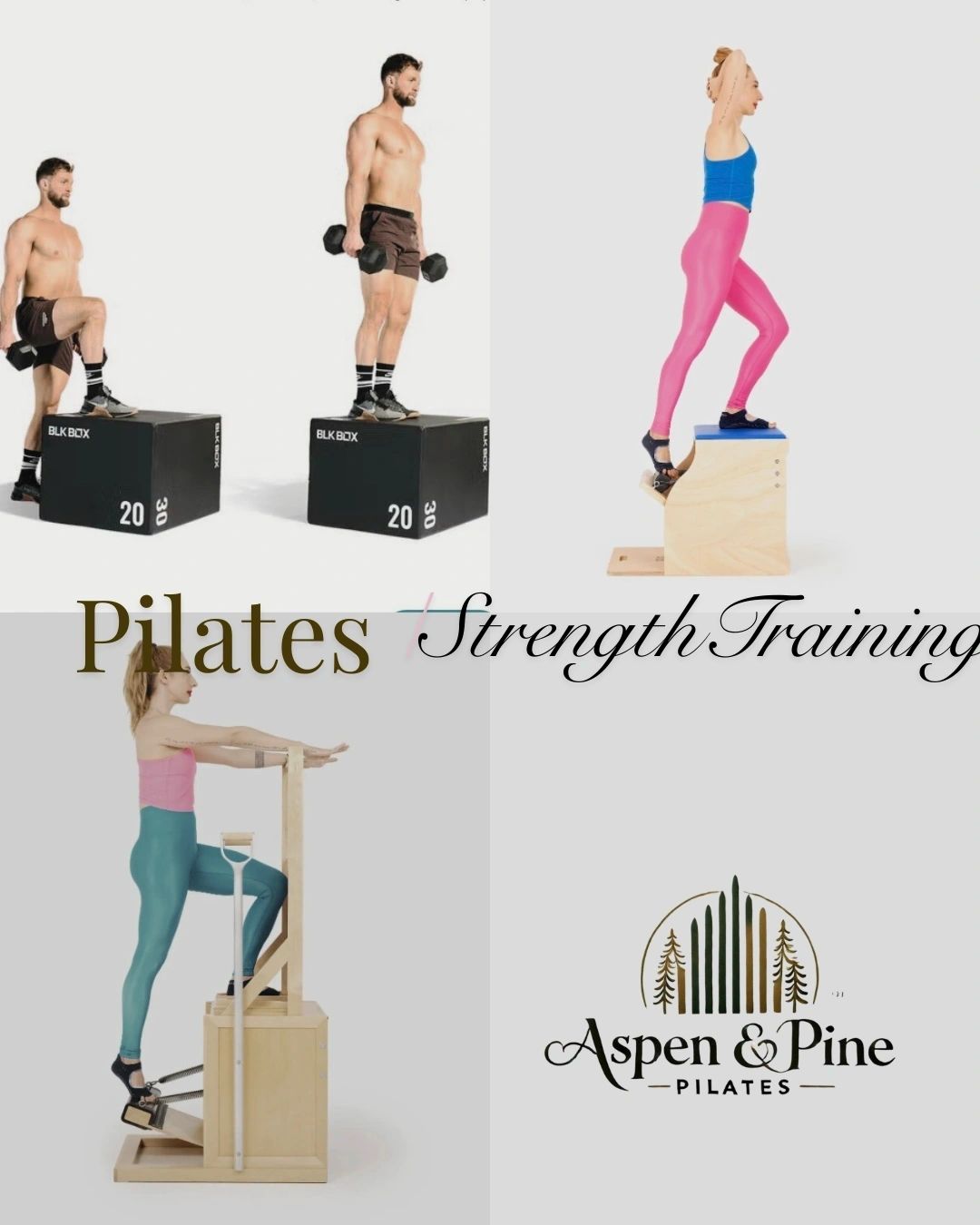
This comparison misses an important point: strength is not defined by equipment—it is defined by force control, joint alignment, and the ability to manage load through movement. One of the clearest ways to understand this distinction is by looking at a deceptively simple exercise: the step-up.
The Step-Up: A Litmus Test for True Strength
A step-up is a single-leg, closed-chain movement that closely mirrors daily life—climbing stairs, hiking, stepping onto a curb. From an exercise science perspective, it is a powerful assessment of functional lower-body strength, balance, and coordination.
A well-executed step-up challenges:
- Gluteus maximus for hip extension
- Gluteus medius and deep hip stabilizers for pelvic control
- Quadriceps for knee extension and deceleration
- Hamstrings and adductors for joint stability
- Core musculature for trunk organization
This is not a “light” exercise when performed correctly. It is strength training—just not momentum-based or bilateral.
Why Step-Ups Often Look Easy (and Aren’t)
In many gyms, step-ups are performed with speed and bounce:
- The back leg pushes excessively
- The knee collapses inward
- The body drops off the step with little control
When this happens, the exercise shifts away from strength development and toward load avoidance.
True strength shows up in the ability to:
- Rise using the working leg without pushing off
- Maintain knee alignment over the second toe
- Control the descent without dropping
These qualities are central to both joint health and long-term resilience—and they are precisely where Pilates excels.
Pilates vs. Traditional Weight Training: A False Dichotomy
Research consistently shows that Pilates improves muscle strength, balance, and functional performance, particularly in the hips, trunk, and lower extremities. Strength gains from Pilates programs are often comparable to other forms of exercise, especially when alignment and tempo are emphasized.
Where Pilates differs from traditional weight training is not in whether strength is developed, but how it is developed.
Traditional resistance training tends to prioritize:
- External load
- Bilateral force production
- Maximal or near-maximal effort
Classical Pilates prioritizes:
- Joint alignment under load
- Neuromuscular control
- Eccentric strength
- Single-leg and asymmetrical challenges
Both have value. But when the goal is durable strength, knee health, and movement longevity, Pilates offers advantages that are often underappreciated.
Knee Alignment: The Strength You Can’t Fake
One of the most common faults seen in step-ups is knee valgus, where the knee collapses inward during the ascent or descent. This is not merely a technique issue—it reflects insufficient control from the hip and poor force transfer through the leg.
Pilates directly addresses this through:
- Emphasis on femur positioning in the hip socket
- Balanced activation of the gluteal complex
- Foot stability and whole-chain integration
When these elements are trained consistently, the knee no longer needs to compensate.
This is why clients who struggle with step-ups often improve dramatically after classical Pilates training—even without “heavy” weights.
The Overlooked Power of the Eccentric Phase
From a science perspective, the eccentric portion of an exercise—the controlled lowering phase—is where much of the protective benefit occurs.
Eccentric training:
- Builds strength at lower metabolic cost
- Improves tendon integrity
- Enhances joint stability
- Increases tolerance to deceleration forces
In a step-up, the descent is where knee health is either reinforced or compromised. Dropping down eliminates the very stimulus that protects the joint.
Pilates, by design, emphasizes controlled eccentrics, whether on the mat, reformer, or chair. This is one reason Pilates is so effective for people seeking strength without joint wear and tear.
What “Enough” Really Mean
If “enough” means maximal hypertrophy or competitive lifting numbers, then no—Pilates is not designed for that outcome. If “enough” means:
- Strong, stable knees and hips
- The ability to control your body on one leg
- Strength that transfers to daily life
- Movement quality that improves with age
Then Pilates is not only enough—it is exceptionally effective when taught and practiced as a system.
The Bottom Line
The step-up exposes the flaw in the “Pilates vs. strength training” argument. Strength is not about how much weight you lift—it is about how well you control force through your joints.
At Aspen & Pine Pilates, we view Pilates as intelligent strength training—one that prioritizes alignment, control, and longevity. When step-ups are performed with the same precision demanded in classical Pilates, they become a clear demonstration that strength is not missing from Pilates at all.
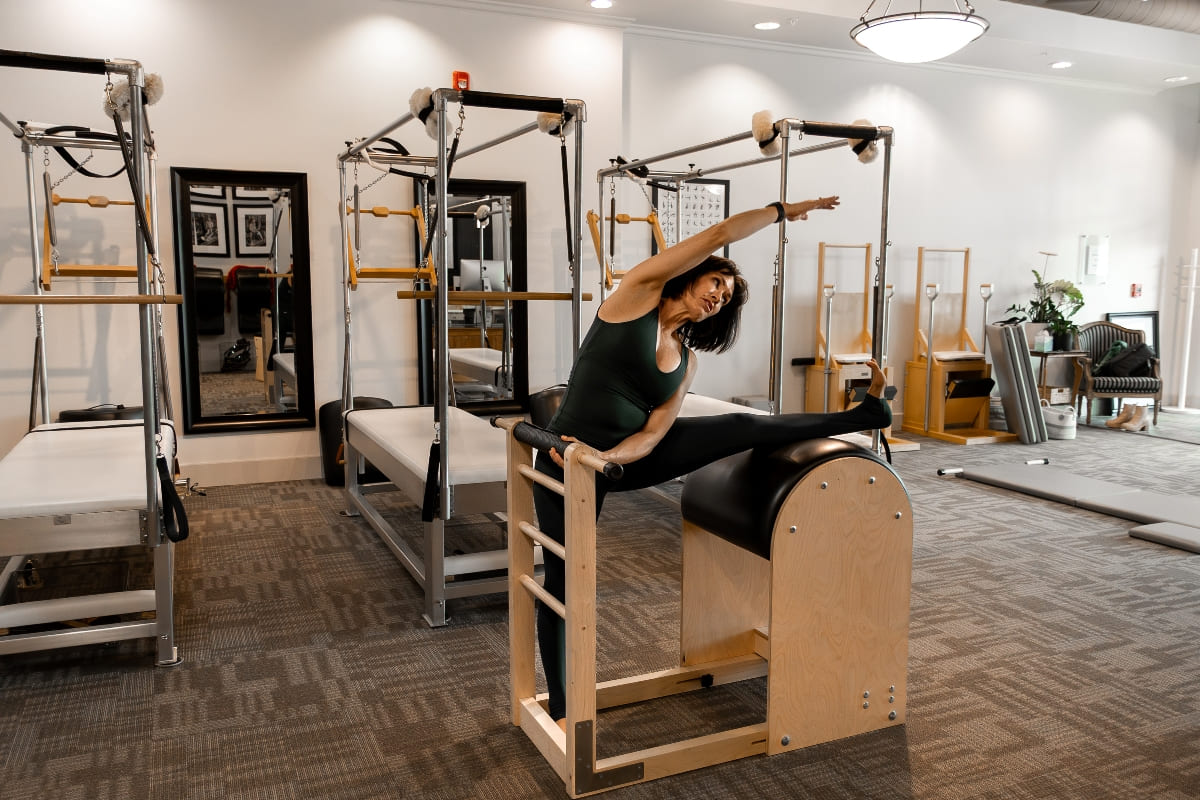
It has simply been misunderstood. After all most people think “pilates is just abs” and is done on a yoga mat or a reformer,